
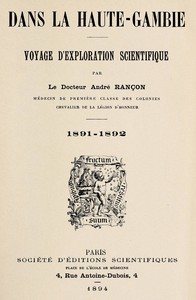
Dans la Haute-Gambie : Voyage d'exploration scientifique, 1891-1892 by A. Rançon
Published in 1894, Dans la Haute-Gambie is André Rançon's official report of his year-long scientific expedition up the Gambia River. But don't let 'official report' scare you off. It reads much more like a detailed, sometimes frustrating, travel journal.
The Story
The French government sent Rançon to explore the Upper Gambia region, which is in modern-day Senegal and Guinea. His job was to map the area, document its geography, plants, and animals, and make observations about the different communities living there. The book follows his journey step by step. You travel with him as he deals with unreliable boats, negotiates for guides and supplies with local leaders, and tries to conduct his scientific work while battling fevers and fatigue. There's no single villain or plot twist. The 'story' is the daily grind of exploration—the small victories of getting a good geographic fix, and the constant setbacks of illness or misunderstandings.
Why You Should Read It
This book is fascinating because it's so unvarnished. Rançon doesn't paint himself as a heroic adventurer. He gets sick, he gets confused, and his colonial perspective is very much a product of its time, which is important to read critically. What shines through is his genuine curiosity. His notes on the customs, architecture, and agriculture of the Mandinka and other groups are incredibly detailed. You get a real sense of a region in a specific moment, caught between its own rich history and the looming wave of colonial change. It’s a ground-level view of history happening.
Final Verdict
Perfect for readers who love primary sources and want to feel the texture of the past. If you enjoyed the travelogues of someone like David Livingstone but want a less famous, more bureaucratic (yet still personal) version, this is for you. It’s also great for anyone interested in West African history, as it provides a snapshot from a very particular and influential viewpoint. Just be prepared: this isn't a swashbuckling adventure novel. It's the real, slow, complicated work of exploration, and that's what makes it so compelling.
You are viewing a work that belongs to the global public domain. It serves as a testament to our shared literary heritage.
Aiden Clark
1 year agoSurprisingly enough, the content flows smoothly from one chapter to the next. I couldn't put it down.
Jessica Miller
1 year agoI have to admit, the author's voice is distinct and makes complex topics easy to digest. A valuable addition to my collection.
Dorothy Nguyen
1 year agoIf you enjoy this genre, it manages to explain difficult concepts in plain English. I will read more from this author.
Matthew Sanchez
2 months agoText is crisp, making it easy to focus.






Sandra Lewis
1 year agoHigh quality edition, very readable.