
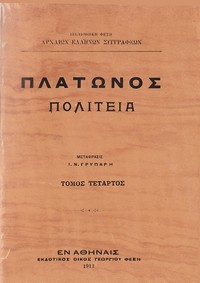
Πολιτεία, Τόμος 4 by Plato
So, what's actually happening in this book? Don't picture a normal story with a plot. Picture a long, intense conversation. Socrates is hanging out with a group of Athenians, including the sharp-tongued Thrasymachus and the brothers Glaucon and Adeimantus. They're trying to figure out the meaning of justice. To make it easier to see, Socrates suggests they imagine building a perfect city, a 'Republic,' from the ground up. This lets them examine justice on a giant scale.
The Story
In this fourth part, they've already laid the foundations. Their ideal city has three classes: Rulers (the wise philosophers), Auxiliaries (the brave soldiers), and Producers (everyone else, like farmers and craftsmen). Here, they get into the nitty-gritty of how this society would actually work. They propose radical ideas to keep the ruling class focused solely on the city's good: no private property, no traditional families (kids are raised communally), and even a state-controlled myth (the 'noble lie') to convince everyone they're born with metals in their souls that determine their role. Then, they turn to the arts, debating whether poets and playwrights should be heavily censored or expelled for depicting gods or heroes behaving badly, arguing it corrupts the citizens' character. Through all this, they finally circle back to define justice: it's each part of the city—and each part of the individual soul—doing the job it's best suited for, without interfering with the others.
Why You Should Read It
You should read this not for answers, but for the quality of the questions. It's mind-bending to see thinkers from 400 BCE wrestling with issues that dominate our headlines today: fake news (the 'noble lie'), censorship, social mobility, and the tension between individual freedom and collective good. Socrates, as a character, is fascinating—he's not just a wise old man, but a relentless debater who dismantles easy assumptions. You'll find yourself arguing with the page. Some proposals will shock you, and that's the point. It forces you to clarify your own values. Is stability worth a foundational myth? Can art be dangerous? It's the ultimate brain workout.
Final Verdict
This is for the curious reader who loves big ideas. It's perfect for anyone who enjoys podcasts or shows about ethics and society, for the aspiring leader wondering about the price of idealism, or for the fiction lover who wants to understand one of the most influential thought experiments in Western history. It's challenging, occasionally frustrating, and absolutely never boring. Just be ready to have your beliefs politely, but firmly, interrogated by a philosopher who's been waiting for you for over two millennia.
There are no legal restrictions on this material. Thank you for supporting open literature.
Liam Sanchez
1 year agoI didn't expect much, but the storytelling feels authentic and emotionally grounded. Highly recommended.
Michelle Thompson
4 months agoThe formatting on this digital edition is flawless.

Michael Jones
1 year agoText is crisp, making it easy to focus.