
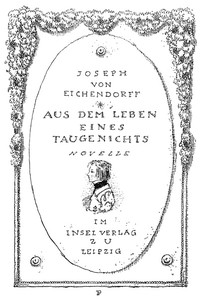
Aus dem Leben eines Taugenichts: Novelle by Freiherr von Joseph Eichendorff
First published in 1826, Joseph von Eichendorff’s Aus dem Leben eines Taugenichts (From the Life of a Good-for-Nothing) is the ultimate Romantic road trip story, told with a lightness of touch that makes it feel incredibly fresh.
The Story
Our nameless hero is a young miller’s son who loves music and hates work. Tired of his father’s complaints, he sets out with his violin to see what life has in store. He finds a job as a gatekeeper at a remote castle, where he instantly falls for a beautiful, noble lady. His simple happiness is shattered when he believes she is to marry another. Heartbroken, he wanders on, through forests and villages, meeting strange travelers, getting mixed up with mysterious painters and counts, and even taking a bewildering trip to Italy. The whole journey feels like a dream—sometimes joyful, sometimes lonely—guided by chance and song, as he searches for his place and the woman he can't forget.
Why You Should Read It
Don’t let the 19th-century publication date fool you. The Taugenichts (the 'good-for-nothing') might be one of the most relatable characters in classic literature. His desire to break free from expectation and find his own path is timeless. Eichendorff’s real magic is in the atmosphere. He paints the natural world—the rustling trees, the warm sun, the nightingales—with such vivid warmth that you can almost feel the breeze. It’s a book that celebrates feeling over thinking, wonder over duty. But it’s not naive. Underneath the wandering and the folk songs, there’s a quiet question: Is this boundless freedom all it’s cracked up to be, or is the hero just running from growing up?
Final Verdict
This is a perfect book for anyone who loves a short, atmospheric read that packs a punch. If you enjoy fairy-tale vibes, poetic descriptions of nature, and stories about finding yourself, you’ll fall for this. It’s also a fantastic, accessible entry point into German Romanticism—you get all the big themes (nature, art, longing) without the heavy philosophical weight. Keep it for a sunny afternoon in the garden or a quiet evening when you feel like being transported. Just be warned: you might finish it with a strange urge to go for a very long walk.
Legal analysis indicates this work is in the public domain. Preserving history for future generations.
Oliver Martinez
11 months agoSurprisingly enough, the depth of research presented here is truly commendable. Truly inspiring.
Sandra Lee
1 year agoHaving read this twice, it challenges the reader's perspective in an intellectual way. This story will stay with me.

Elizabeth Williams
3 months agoWithout a doubt, the atmosphere created is totally immersive. Definitely a 5-star read.