
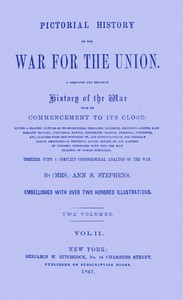
Pictorial history of the war for the Union, volume 2 (of 2) : A complete and…
Ann S. Stephens's Pictorial History of the War for the Union, Volume 2 is the concluding piece of a monumental effort. Published just a year after the war ended in 1866, it aims to be a complete and immediate record. This isn't a single narrative from one person's point of view. Instead, Stephens acts as a compiler and guide, weaving together official battle reports, soldiers' personal letters, political speeches, and newspaper accounts from both Northern and Southern sources.
The Story
This volume picks up the thread of the war, covering the later, brutal years. It follows the major campaigns and turning points, from the grinding warfare in Virginia to Sherman's famous March to the Sea. But the 'story' is really the cumulative weight of countless smaller stories. You'll read a soldier's description of camp life, then see an engraving of the terrain he fought on. You'll find the full text of critical addresses alongside portraits of the men who gave them. The plot is history itself, presented not as a settled fact but as a living, breathing, and often confusing event, reported with the urgency of the moment.
Why You Should Read It
The power of this book is in its immediacy. There's no 150 years of historical analysis smoothing things over. The grief, the patriotism, the confusion, and the sheer scale of the conflict are all right there. The hundreds of woodcut illustrations are a game-changer. They transport you in a way text alone cannot. You see the fashion of the uniforms, the layout of a prison camp, the destruction of cities. It makes the war tangible. Stephens, a popular novelist of her time, also has an eye for the human element. She includes stories of individual bravery and tragedy that might have been lost, giving faces to the enormous numbers.
Final Verdict
This is a treasure for anyone who loves American history and wants to go beyond the summaries. It's perfect for the Civil War enthusiast who has read the modern biographies and analyses and now wants to explore the primary source material in a beautifully organized, accessible format. It's also fantastic for visual learners and anyone who appreciates historical artifacts. Be warned: it's a product of its time, with the perspectives and language of the 1860s. But that's also its greatest strength. It's not just a book about the Civil War; it's a firsthand artifact of how America began to remember it.
This content is free to share and distribute. Enjoy reading and sharing without restrictions.
Ashley Taylor
10 months agoI have to admit, the content flows smoothly from one chapter to the next. One of the best books I've read this year.
Daniel Moore
8 months agoUsed this for my thesis, incredibly useful.

Andrew Clark
10 months agoSurprisingly enough, the flow of the text seems very fluid. Worth every second.